


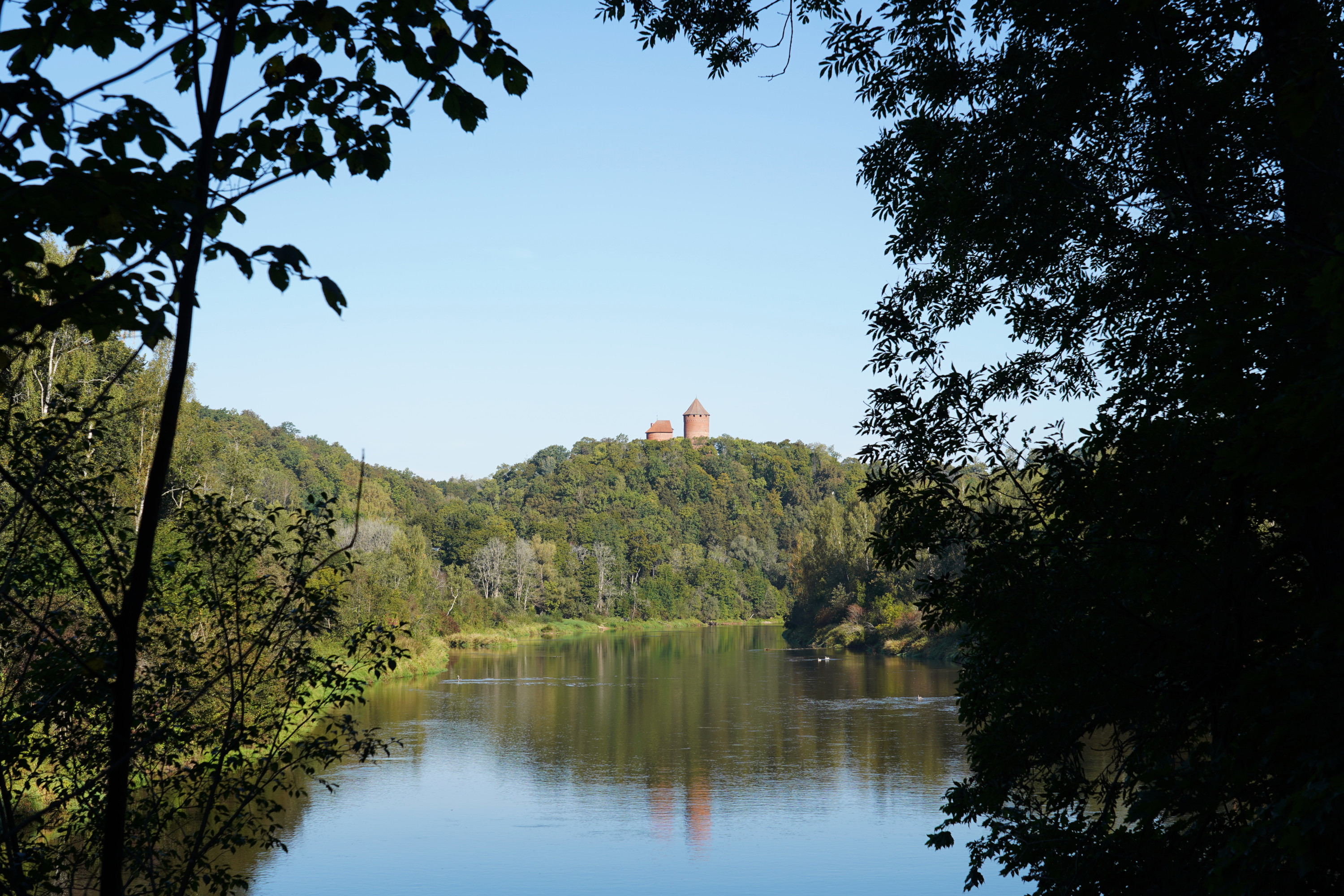
Our trip continued in Latvia. The weather had become much better, dry and sunny. In Riga, we had some high fog until noon, but only thin.
Overview
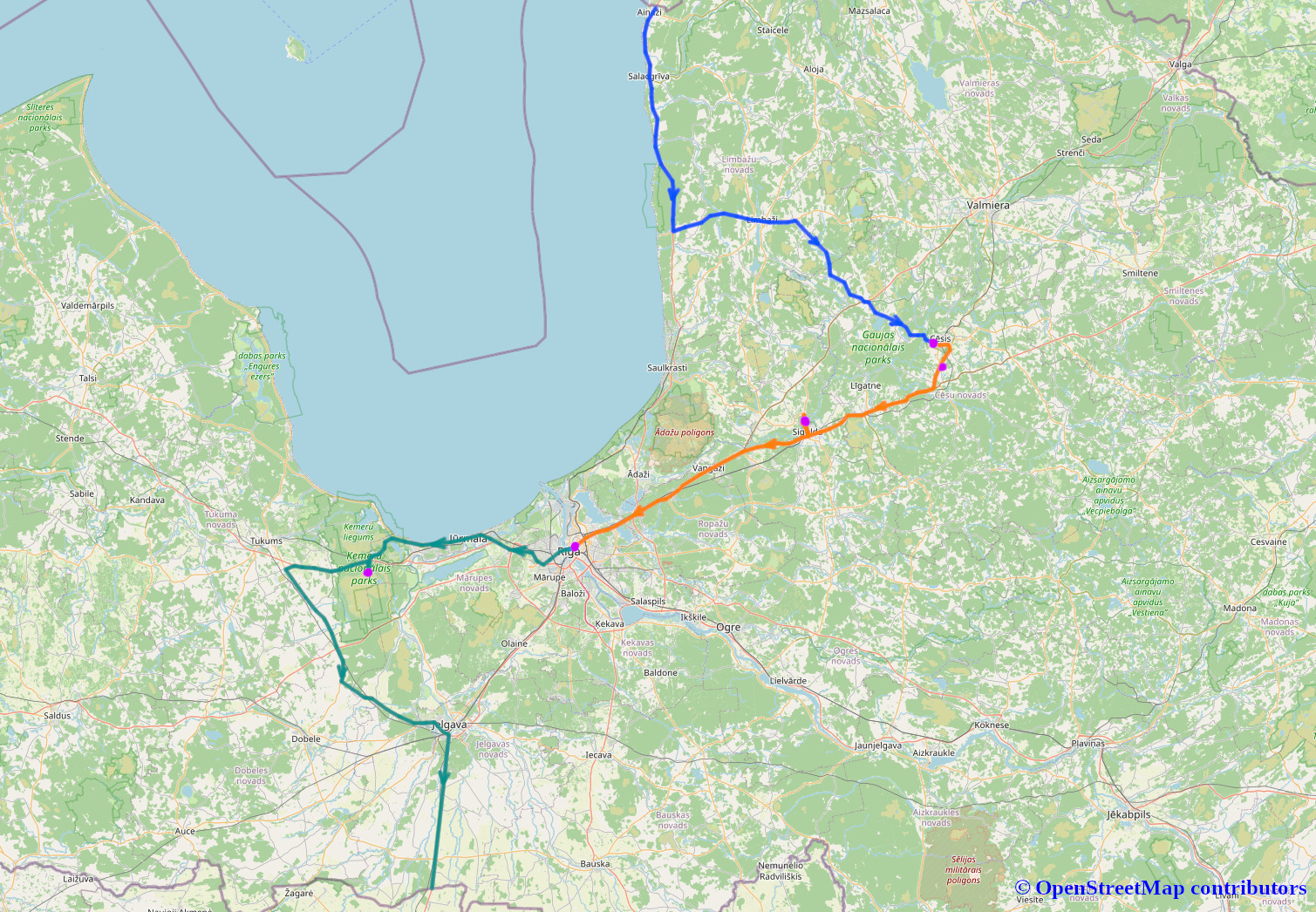
This map shows our journey across Latvia. It began at the northern border crossing from Estonia, then proceeded directly to Cēsis. From there, we traveled via Sigulda to Riga, Latvia’s capital. After spending a full day sightseeing there, we were impressed by the vast bog near Ķemeri. Then we headed straight south toward Lithuania; there is no border crossing there, only a sign.
Cēsis
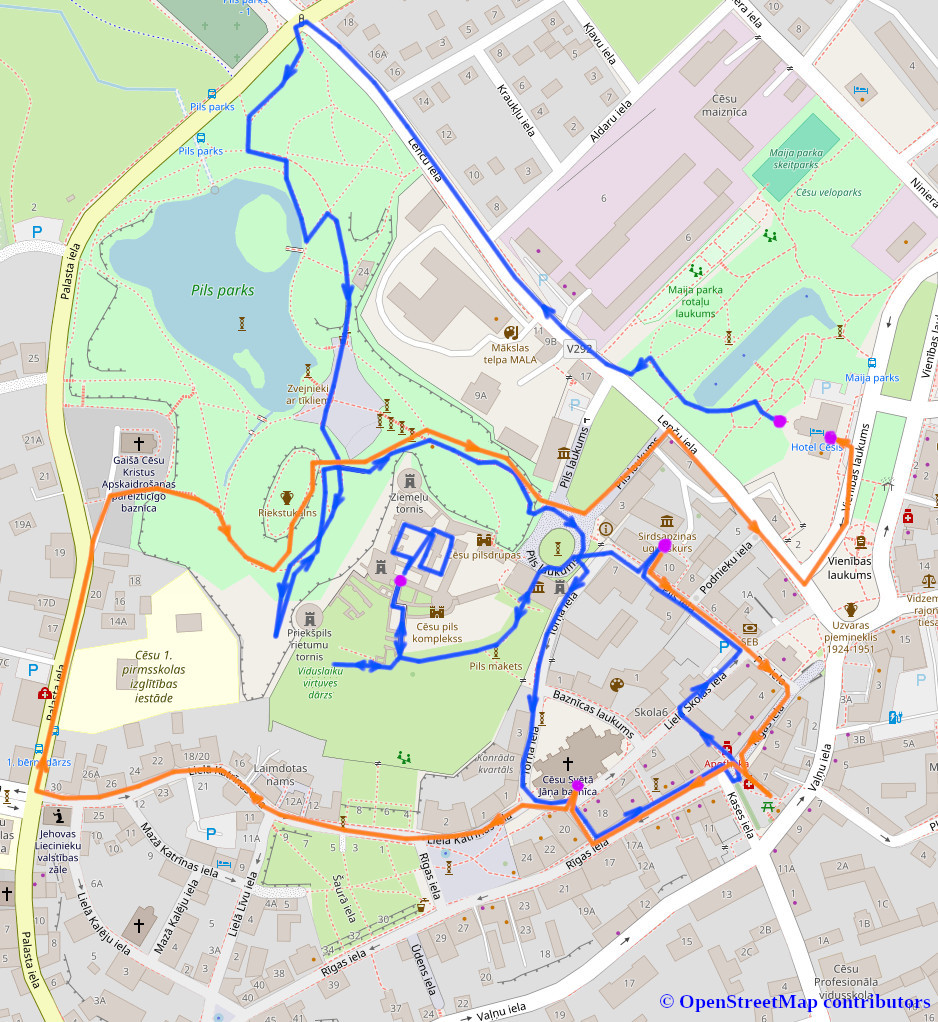
The German name for the city of Cēsis (pronounced "Tseh-sis") is "Wenden"; however, this has nothing to do with the Wends (Slavic people in Germanic territories) but rather originates from the Livonian language. People come here primarily to visit Cēsis Castle, a former stronghold of the Teutonic Order. Built in the 13th century, it is the best-preserved castle ruin in Latvia.
Very close to the town lies the Zīpari farm, where wooden shingles are crafted using traditional methods, fruit is grown, and honey is produced. After a brief tour of the farm, we were invited to enjoy a typical Latvian dinner there.
A lovely hotel (shown on the right side of the map) offered us a chance to relax in its small park. Our scheduled tour began there along the blue route; later that afternoon, I walked the orange route.
Sigulda
Anyone interested in winter sports has surely heard of the luge and bobsleigh track in Sigulda. We paid a brief visit there, though naturally, with it being well outside the season, no athletes were present.
Sigulda lay on our route from Cēsis to Riga, but we had plenty of time to admire the magnificent scenery. The town is situated at a valley deeply carved by the Gauja River, and the cable car ride across the valley offers beautiful views. The area is often referred to as "Latvian Switzerland."
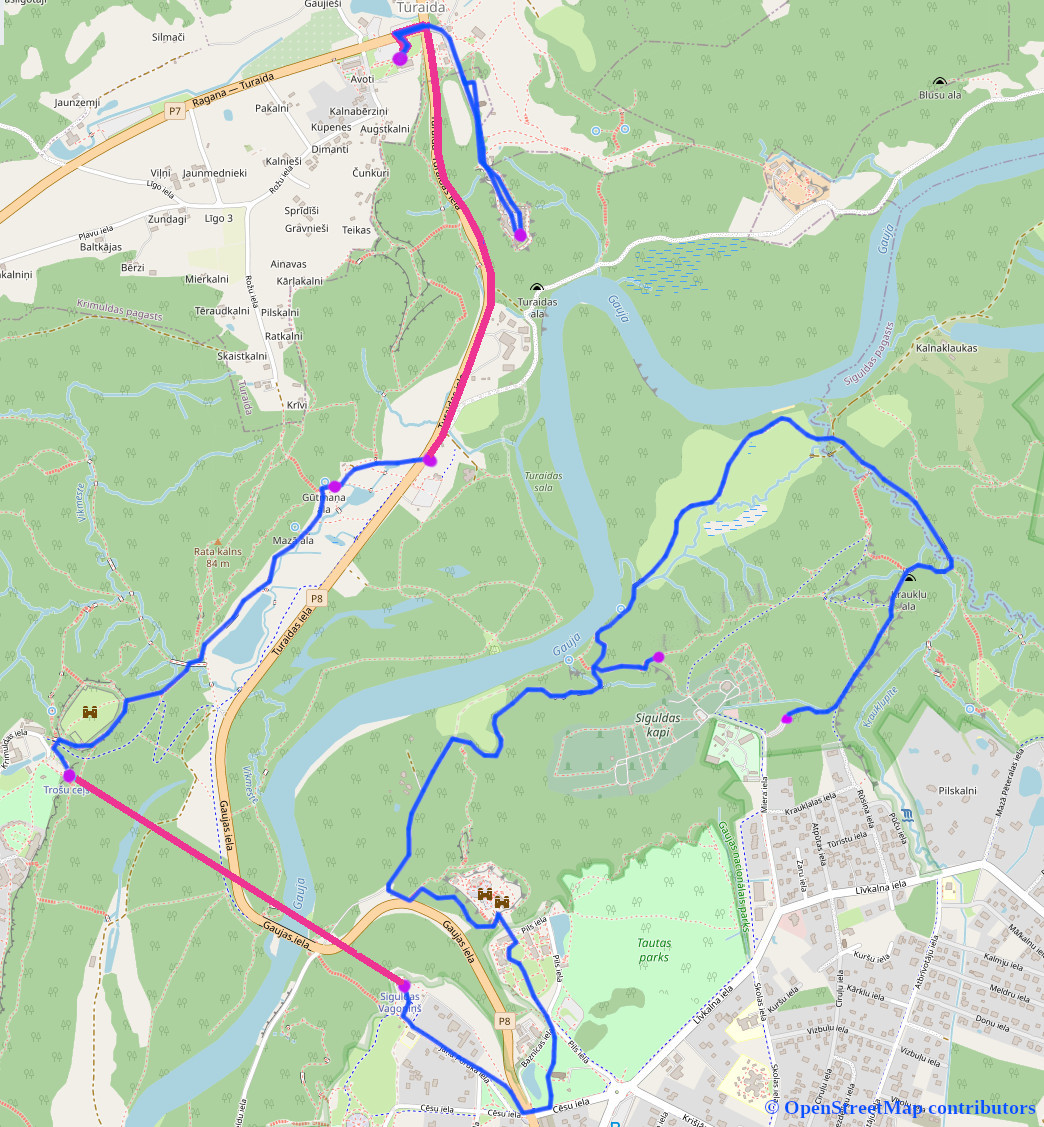
In addition to the landscape, there were, of course, castles to admire here as well. Tucked away on the hill reached by the cable car, you can find the ruins of Krimulda Castle. A little further on, you reach the Turaida Museum Reserve, home to another well-preserved castle.
The blue paths on the map indicate our walking routes; the cable car ride is visible as a red line at the bottom, and we took the bus from Gutman's Cave to Turaida (also in red).
Rīga
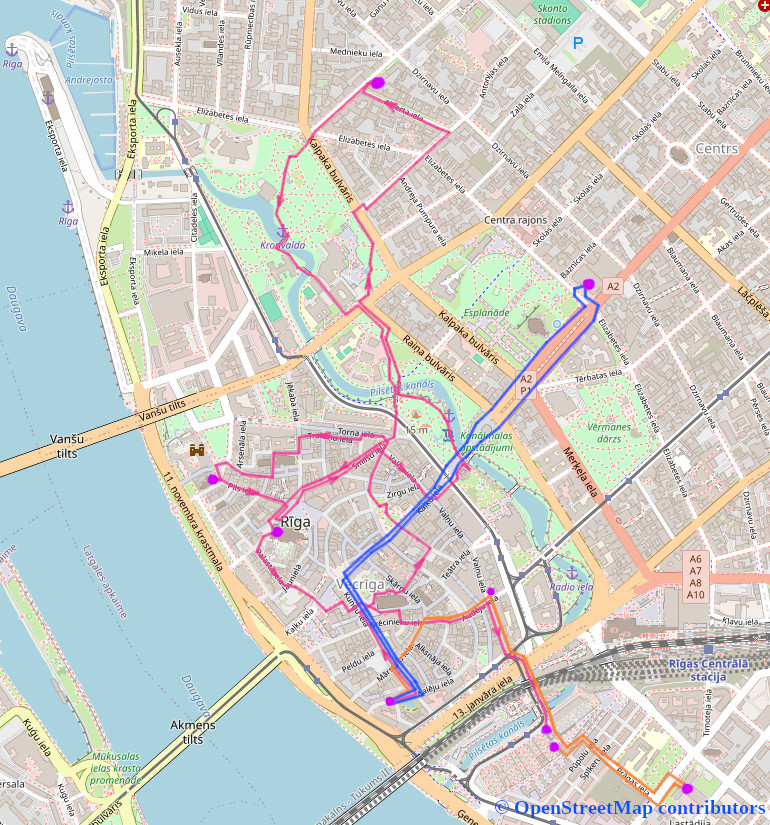
Latvia’s capital was a particularly fascinating stop on our trip. The density of Ferraris in the parking lots was staggering; perhaps the only place with a higher concentration would be Monaco. During the day, the city offers plenty of history and ecclesiastical architecture. Once darkness falls, the streets of the Old Town teem with people, and there is live music every few meters.
We spent a full day here, but one could easily have spent another day in the city.
Our sightseeing tour began at our hotel (bottom center of the map, above the railway line). The red route marked our official itinerary, taking us from the Cathedral up to Albert Street (famous for its Art Nouveau facades). In the afternoon, I walked the orange route to the Academy of Sciences (bottom right); the building is a prime example of Stalinist Eastern Bloc architecture but offers a fantastic panoramic view in all directions. In the evening, we visited the lounge at the Radisson Blu Hotel (blue route).
Photo collection
Public images
Click on a photo to enlarge it. Members of my travel group may ask me for a passwort to unlock photos with visible group members.


Latvian language
Unlike Estonian—the language of its northern neighbor—Latvian belongs to the Indo-European language family, making it related to German and English. However, one shouldn't overstate this connection, as Russian and Polish share a similar relationship. Even if you think you recognize a few words, you are still far from being able to simply understand Latvian. The word you encounter most often while strolling through the streets is "iela" (English: "street"), which is most likely linked to the Latin verb "ire" (to go).
Latvian orthography, on the other hand, is highly phonemic; by and large, the language is pronounced exactly as it is written. There are a few special diacritics:
- A macron (a horizontal bar) over a vowel indicates that it is pronounced as a long vowel, as in Rīga.
- Some letters feature a comma-like mark either below or above them (ģ, ķ, ļ, ņ), indicating palatalization. Simply put, the consonant sounds as if followed by a "y" sound—for instance, *ņemt* sounds like "nyemt."
- Some letters may have a háček (an inverted caret) above them: č, š, ž. These are pronounced "ch" (as in *church*), "sh" (as in *shoe*), and a voiced "zh" (like the *s* in *measure* or the initial sound in *journal*), respectively.
There is also something interesting regarding diphthongs (double vowel sounds): Latvian has no "eu" sound—neither the "oi" nor the "ew" or "you" variety. In Latvian, Europe is called "Eiropa", and the Euro is referred to as "Eiro" or "Eira", even though the EU Commission mandated the official use of the name "Euro." The debate over the currency's proper name evidently continues.
As a rule, both elements of a diphthong should be clearly articulated; notably, "ie" is not a long "i" sound but is pronounced like "ee-a"—hence "ee-ala" for the word "iela" (street). The remaining letters are practically the same as in English. Exception: The letter C is always pronounced like "ts," regardless of what follows.
And there is another particularly striking feature: masculine words end with an S, and if one isn't already there, it is added—as in "Johans Gotfrīds Herders" (Johann Gottfried Herder). Old Indo-European conventions shine through here; one need only think of the "-us" endings in Latin.
Here are the first five numbers again:
| Number | Latvian |
| 0 | nulle |
| 1 | viens |
| 2 | divi |
| 3 | trīs |
| 4 | četri |
This already sounds much more familiar than Estonian. And yet, precisely because of the palatalization and the "sh" sounds, Latvian actually sounds a bit like Russian to my ears.
In Latvian, the word for Germany is Vācija—quite an unusual form that differs significantly from all other names for the country. One theory suggests it stems from "vaca," meaning "Viking," while another posits that it contains the Old Prussian word "wackis"—meaning "(war) cry"—referring either to warlike raids or simply denoting a language from which the locals understood nothing but unintelligible shouting (similar to the origins of the word "Nemets" in Slavic languages).
And now in Latvian: Un tagad izbaudiet manas bildes no Latvijas!